The Mirena IUS: What the Research Actually Says
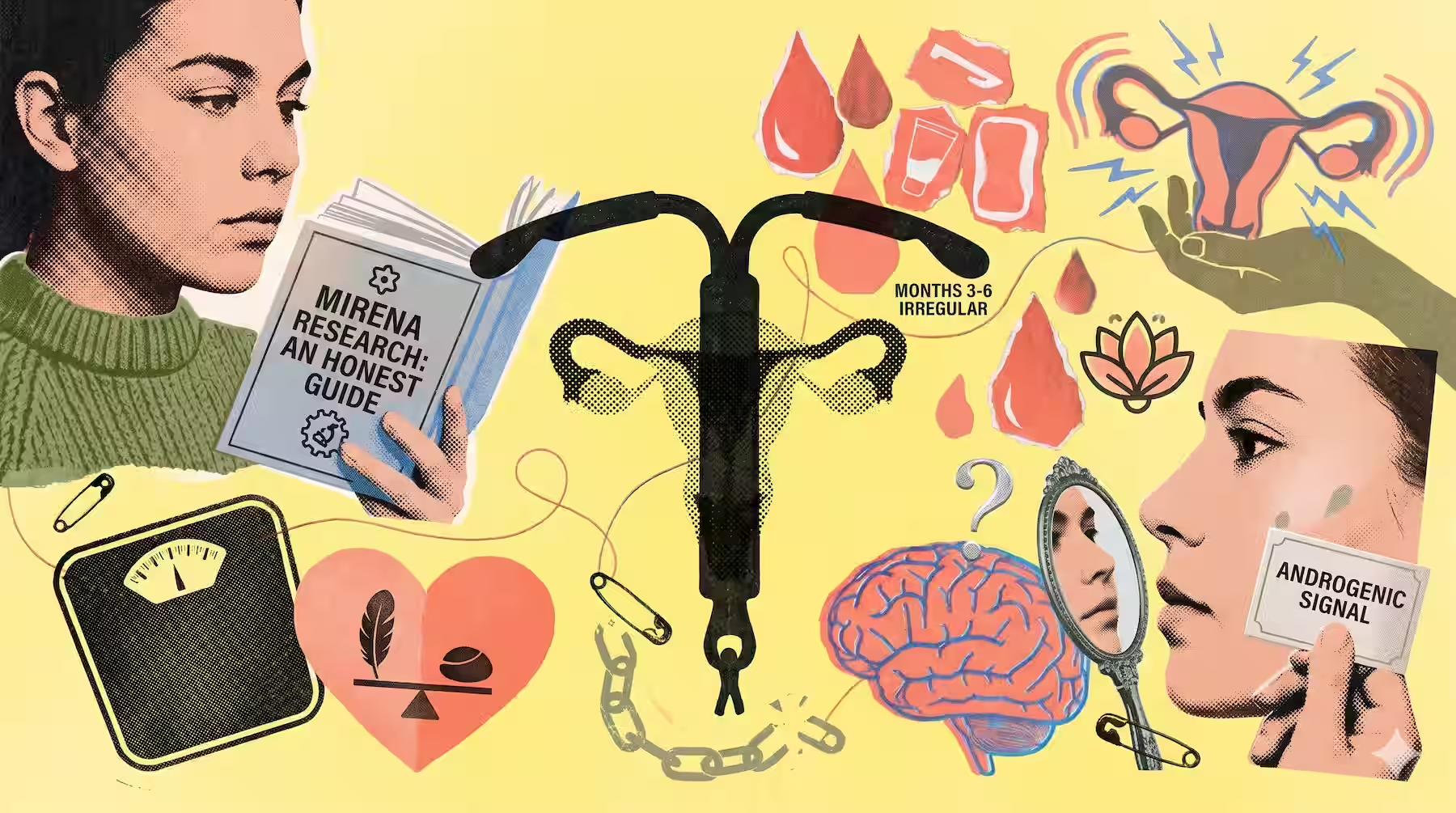
The Mirena is hugely popular, so if you ask around or do a deep dive, the results can be alarming. Friends, online forums and social media paint a picture that doesn’t always match what the research shows — but some of those concerns have also been dismissed by doctors too quickly.
So what’s actually true? Here is an honest, evidence-based look at the most common complaints, with real numbers.
What is the Mirena?
The Mirena is a small, T-shaped device placed inside the uterus that releases a low dose of a progestogen called levonorgestrel directly into the uterine cavity. It is one of the most effective forms of reversible contraception available, and is also used to manage heavy periods and endometriosis. A 52 mg LNG-IUD inserted before age 45 is approved for up to eight years of use.

✅ REAL: Bleeding changes
This is the most common complaint — and the most misunderstood.
In the first three to six months, irregular spotting and light bleeding are very common. This is a normal physiological response, not a sign something has gone wrong. By two years of use, around 50% of Mirena users have little or no period at all. Many people welcome this. Others find it unsettling — particularly if no one warned them it would happen.
Importantly, the absence of periods does not mean your body has stopped ovulating. One study found that 63% of amenorrhoeic Mirena users were still ovulating normally — the device simply prevents the uterine lining from building up enough to shed. Removal for bleeding-related reasons occurs in approximately 7–10% of users within 12 months.
The takeaway: Bleeding changes are real and common, but largely predictable. Being told what to expect before insertion is the single most effective way to reduce early discontinuation.
✅ REAL: Insertion can hurt
This is an area where patients have long been right and the medical profession has been slow to respond.
Insertion pain is real, varies considerably between individuals, and tends to be worse for those who haven’t had a vaginal delivery. In one study of 75 women, the most common pain score was 8 out of 10, and 46% said the pain was higher than anticipated. Nulliparous women reported significantly higher scores than those who had previously given birth. Clinicians also consistently underestimate how much pain their patients experience.
Pain relief options have historically been limited. A systematic review of topical and injected (paracervical block) lidocaine found only mild effectiveness, with the overall evidence base described as “scanty and inconclusive.” ACOG acknowledges that more research is needed to identify truly effective interventions. Misoprostol, once thought to help soften the cervix, has not been shown to reduce pain and may delay the procedure.
More promising is a recent controlled trial published in 2026 (Ouyang et al., AJOG). Rather than a single ibuprofen tablet taken immediately before the procedure — which has shown limited benefit — this study tested a multi-dose regimen of ibuprofen 800 mg three times in the 24 hours before insertion. Across 80 participants, those who received ibuprofen reported significantly lower pain scores than those who received placebo, with the difference meeting the threshold for clinical significance. There was no difference in pain or additional analgesia use at 24 hours after the procedure. This suggests that pre-emptive, sustained anti-inflammatory cover — rather than a single pre-procedure dose — may be a simple and practical strategy for reducing insertion pain.
The takeaway: Your pain is valid. If you are planning to have a Mirena inserted, ask your doctor about taking ibuprofen on a scheduled multi-dose basis in the 24 hours beforehand. It is also okay to ask for a pause during the procedure.
⚠️ UNCERTAIN: Mood changes and depression
This is the most debated area in Mirena research, and the evidence is genuinely conflicting.
Studies that found a link:
- Skovlund et al. (2016), JAMA Psychiatry — a Danish nationwide cohort of over 1 million women found that LNG-IUD users had a relative risk of 1.4 for first antidepressant use compared to non-users, with the highest risks in adolescents.
- Slattery et al. (2018), Drug Safety — a UK cohort study found a moderate association between LNG-IUD use and psychiatric adverse events in general practice.
- Uppsala University cohort (2021) — a large Swedish cohort found levonorgestrel IUD use associated with a relative risk of 1.59 (95% CI 1.46–1.73) for depression — the highest risk of any hormonal contraceptive studied.
Studies that found no link:
- Worly et al. (2018), Contraception — a systematic review of RCTs found no association between progestogen-only contraception and depression.
- Bürger et al. (2021), BJPsych Open — a network meta-analysis of randomised trials found no significant association between hormonal contraceptive use and depressive symptoms.
- A separate Swedish cohort using a fully adjusted model found only a modest residual risk increase (RR 1.34) after controlling for confounders, with combined pill users actually showing lower rates of depression than non-users.
Why the evidence is so difficult to interpret:
True double-blind RCTs are ethically impossible — women in a placebo group would be at risk of unintended pregnancy. Observational studies cannot fully account for confounders including age, stress, relationship changes, and pre-existing mental health. “Depression” in database studies typically means a first antidepressant prescription, which is an imperfect proxy. And women who experience mood changes are more likely to stop using the device, meaning those who remain in long-term studies skew towards those who tolerate it well — a form of selection bias that may mask a real effect in a subset of users.
Absolute risk also matters here: if 10–15% of women of reproductive age will experience depression regardless of contraception, even a 40% relative risk increase means the large majority of users are unaffected.
RANZCOG states that “the available evidence does not establish a causal relationship between progestogen-only contraception use and depression,” while acknowledging mood-related complaints are reported by some users. The FSRH similarly concludes that evidence is “too limited to confirm or exclude a causative effect.”
The takeaway: The signal is real enough that it should not be dismissed. If you notice mood changes after insertion, that experience deserves medical attention. But the evidence does not support the conclusion that the Mirena causes depression in most people. For women with a prior history of depression or anxiety, a detailed discussion before choosing this method is worthwhile.
✅ REAL (but often mild): Acne
Unlike weight gain or libido changes, acne is backed by consistent evidence and frequently under-discussed in pre-insertion counselling.
- A retrospective cohort study (n=1,224) found that LNG-IUD users had an odds ratio of 2.51 for new-onset acne within one year compared to copper IUD users.
- A prospective cohort study (n=1,319) found that up to 28.5% of progestogen-only IUD users reported new or worsening acne after eight weeks of use. Discontinuation due to acne was rare (3%).
- LNG-IUD users had a higher risk of escalating from topical to oral acne treatment compared with combined pill users (hazard ratio 1.44).
RANZCOG notes a causal association “cannot be confirmed or excluded,” with symptoms appearing more prominent in the first months before often settling.
The takeaway: Acne is a genuine androgenic side effect of levonorgestrel. If you have acne-prone skin or a history of hormonal acne, this is worth discussing before you decide.
❌ MYTH: Weight gain
Frequently cited online; not supported by controlled evidence.
ACOG states that weight gain in LNG-IUD users is “comparable to those using the copper IUD” — a device with no hormones at all. RANZCOG confirms “there is no clear evidence that progestogen-only methods cause significant weight gain,” and the FSRH Intrauterine Contraception Guideline (2023) agrees.
If Mirena users and copper IUD users gain weight at equivalent rates over time, the hormones are not the cause. The weight changes reflect normal life.
The takeaway: Weight gain is not a proven side effect of the Mirena. If your weight has changed, other factors — diet, activity, stress, age — are far more likely explanations.
❌ MYTH: Loss of sex drive
The FSRH Intrauterine Contraception Guideline (2023) explicitly states that studies “do not suggest that IUC use is associated with a negative effect on libido,” and direct comparisons between Mirena and copper IUD users find no significant differences in sexual function.
The takeaway: Reduced sex drive is not a confirmed Mirena side effect. If you are experiencing libido changes, mood, relationship factors, sleep quality, and general health are more plausible contributors and worth exploring with your doctor.
⚠️ REAL (but small): Breast cancer risk
This is a genuine signal that belongs in any honest pre-insertion conversation.
- Soini et al. (2014/2016), Acta Oncologica — a nationwide Finnish cohort of 93,843 LNG-IUS users found a standardised incidence ratio (SIR) of 1.19 for breast cancer compared to the general population, rising to approximately 1.40 among women who purchased more than one device over ten or more years.
- Mørch et al. (2017), New England Journal of Medicine — a Danish cohort of 1.8 million women found current or recent LNG-IUD use associated with a relative risk of approximately 1.21 for breast cancer.
- Yi et al. (2024) — a Swedish cohort of over 2 million women found a 13% higher risk of breast cancer among LNG-IUD users.
- Not all studies agree: Dinger et al. (2011) — a large case-control study (n=25,565) — found no increased risk compared to copper IUD users (OR 0.99).
The FSRH (2023) states the potential increased risk “appears to be small.” RANZCOG confirms “the absolute risk remains very small and returns to baseline within five years of discontinuation.”
For context: the absolute risk increase is comparable to, or smaller than, that associated with moderate alcohol consumption. For a woman in her 30s, the background risk of breast cancer is already low.
The takeaway: A small but real risk signal exists and should be part of an informed discussion with your doctor. It is not a contraindication for most people, and the risk returns to normal after removal.
✅ REAL (but uncommon): Perforation and expulsion
Perforation (the device passing through the uterine wall) occurs in approximately 1–2 per 1,000 insertions. Risk is higher in women who are breastfeeding or gave birth within the previous six months. Most cases are identified early and managed without difficulty, though retrieval occasionally requires a laparoscopic procedure.
Expulsion (the device being pushed out on its own) has an overall rate of approximately 1 in 20 (5%) at five years, with expulsion most common in the first year — especially the first three months. Higher rates are seen with postpartum insertion, in adolescents, and in women with fibroids or uterine cavity distortion. Importantly, nulliparous women do not have higher expulsion rates than women who have given birth when the device is inserted at a routine interval.
The takeaway: Both complications are uncommon but real. Checking for the strings after your first period following insertion is recommended. Persistent pelvic pain after insertion always warrants assessment.
❌ MYTH: The Mirena causes ectopic pregnancy
This claim confuses relative and absolute risk.
The Mirena is so effective at preventing all pregnancies that the absolute rate of ectopic pregnancy is far lower in Mirena users than in women using no contraception. ACOG confirms that ectopic pregnancy remains uncommon across all IUD users.
The confusion arises because if a pregnancy does occur with the Mirena in place — which is extremely rare — it is proportionally more likely to be ectopic. But the device does not cause ectopic pregnancy; it dramatically reduces your overall risk of one.
The takeaway: The Mirena protects against ectopic pregnancy. It does not cause it.
❌ MYTH: The Mirena permanently affects fertility
StatPearls (NCBI) confirms that data “do not suggest an increased delay in return to fertility for nulliparous IUD users.” The UK Medical Eligibility Criteria 2025 likewise confirms no meaningful fertility impairment after IUD use across all groups.
The takeaway: The Mirena is fully reversible. Fertility returns promptly after removal for the vast majority of people.
The bottom line
The Mirena is safe and highly effective for most people. I have many patients, friends, and colleages that love their Mirena. But it is not without genuine side effects for a small number of users. Irregular bleeding, insertion pain, and acne are real and worth knowing about in advance. Mood changes remain scientifically uncertain but deserve to be taken seriously when they occur. Breast cancer risk represents a small but real signal, and belongs in any honest pre-insertion conversation.
Weight gain and loss of libido? The evidence does not support either.
The most important thing is that you feel genuinely informed before making your decision — and that if something feels wrong after insertion, your concerns are heard. If the device is not right for you, it can be removed at any time.
References
Ouyang Y, et al. Pre-procedure multi-dose ibuprofen for intrauterine device insertion pain: a randomised controlled trial. Am J Obstet Gynecol. 2026. (n=80; ibuprofen 800 mg three times in the 24 hours before insertion significantly reduced pain vs placebo)
Skovlund CW, Mørch LS, Kessing LV, Lidegaard Ø. Association of hormonal contraception with depression. JAMA Psychiatry. 2016;73(11):1154–1162. (>1 million Danish women; LNG-IUD relative risk 1.4 for first antidepressant use)
Uppsala University cohort. DiVA. 2021. (large Swedish cohort; LNG-IUD associated with relative risk 1.59 [95% CI 1.46–1.73] for depression — the highest risk of any hormonal contraceptive studied)
Worly BL, Gur TL, Schaffir J. The relationship between progestin hormonal contraception and depression: a systematic review. Contraception. 2018;97(6):478–489. (systematic review of RCTs; no association found between progestogen-only contraception and depression)
Mørch LS, et al. Contemporary hormonal contraception and the risk of breast cancer. N Engl J Med. 2017;377:2228–2239. (1.8 million Danish women; LNG-IUD relative risk approximately 1.21 for breast cancer)
Soini T, et al. Cancer risk in women using the levonorgestrel-releasing intrauterine system in Finland. Acta Oncologica. 2014; updated 2016. (93,843 Finnish LNG-IUS users; standardised incidence ratio 1.19 for breast cancer, rising to ~1.40 with more than ten years of use)
Yi JH, et al. Levonorgestrel intrauterine system use and breast cancer risk. Am J Obstet Gynecol. 2024. (>2 million Swedish women; 13% higher breast cancer risk in LNG-IUD users)
Dinger J, et al. Levonorgestrel-releasing and copper intrauterine devices and the risk of breast cancer. Contraception. 2011;83(3):211–217. (case-control study; n=25,565; odds ratio 0.99 — no increased breast cancer risk vs copper IUD)
Averbach SH, et al.; Yland JJ, et al. Acne and levonorgestrel intrauterine system use. (retrospective cohort n=1,224: odds ratio 2.51 for new-onset acne vs copper IUD within one year; prospective cohort n=1,319: 28.5% of LNG-IUD users reported new or worsening acne at eight weeks)
Faculty of Sexual & Reproductive Healthcare (FSRH). Intrauterine Contraception. Clinical Guideline. London: FSRH; 2023. (no evidence of effect on libido or weight; perforation rate 1–2 per 1,000 insertions; potential breast cancer risk increase described as small)
This article is for general information only and does not constitute individual medical advice. Please speak with your doctor or gynaecologist about whether the Mirena is the right choice for you.